




Development Trends of Rubber Extruders
Time:
2022-10-17
The meshing zone of the screw elements in a rubber extruder exhibits a significant velocity gradient, which facilitates thorough mixing of the material within this region. Along the axial direction of the screw, the rubber extruder is divided into an feeding section, a conveying‑mixing section, and a discharging section.
Rubber extruder The meshing zone of the screw elements exhibits a significant velocity gradient, which facilitates thorough mixing of the material within this region. Along the axial direction of the screw, the rubber extruder is divided into an feeding section, a conveying‑mixing section, and a discharging section.
In the mixing section of the extruder, the screw and the inner wall of the barrel feature opposite thread directions; the number of threads along the flow channel gradually increases, while the thread depth progressively decreases. As a result, the cross‑sectional area dedicated to mixing and conveying gradually returns to its original state. During the formation of the helical flow channels, the number of flow paths on the barrel’s inner wall is comparable to that of the helical flow channels, and the depth of these flow channels is inversely proportional to the screw’s pitch.
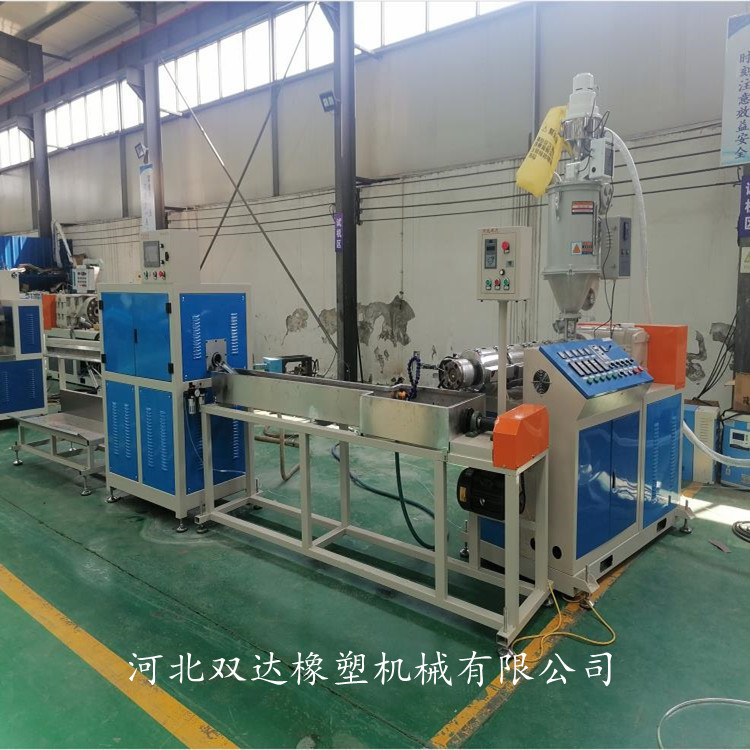
Rubber extruders differ fundamentally from conventional cold-feed extruders. While standard screw extruders rely on friction to achieve plasticization, rubber extruders depend on mechanical action for this purpose, with very little friction. Consequently, the screw length of a rubber extruder is much shorter than that of a conventional extruder—typically only about seven times the screw diameter.
Rubber extruders can be used to produce semi-finished products such as compounded rubber and tread rubber that is easy to extrude, as well as high‑synthetic‑rubber‑content materials that are more difficult to extrude, delivering excellent surface quality and precise profile geometry. Extruders equipped with Ministry‑of‑Transport‑approved screws are shorter than standard extruders, making it easier to combine two or three extruder units to achieve “compound” extrusion and co‑extrusion of complex parts. For example, a 95‑mm primary rubber extruder paired with two 50‑mm secondary extruder units can form a “three‑stage compound” extruder.
Due to Rubber extruder The plasticizing and mixing zone is short, and the flow channels formed by the helical fins and venting holes exert a shearing effect on the material. This results in lower material temperatures within the machine, enabling higher screw speeds and greater production capacity. Typically, in MCT extrusion using a screw extruder, with the die head, bearings, and feed zone set at specific temperatures, under identical temperature‑rise conditions, the rubber extruder exhibits a higher production capacity than both the pin‑barrel extruder and the smooth‑barrel extruder.
By the late 1990s, hundreds of rubber extruders had already been put into operation worldwide; in North America alone, more than 100 were employed for both cold- and hot‑roll tire production, working in tandem with CTC‑SBI and CTC‑SII extruders/molding machines to directly extrude MCT onto the tire carcass. This not only enhanced product quality but also reduced labor and material costs. At the end of the 1990s, the German Rubber Technology Institute began exploring the use of ultrasonic technology to lower elastomer viscosity. Major rubber extruder manufacturers in Europe and North America subsequently positioned extrusion as a new frontier for development. A key advancement was the refined MCT extruder. The third‑generation MCTD extruder and the pin‑type MCT extruder may represent future directions, particularly the pin‑type MCT extruder, which combines the advantages of both pin‑screw and MCT extruders, offering substantial market potential and room for further growth.
Rubber extruder The die is a critical component that determines the quality of extruded products. Traditional single-screw extruder dies can only produce a single type of rubber product; their structure is relatively simple and the die pressure is comparatively low, making technical issues easier to address. With the advancement of extrusion technology and evolving production requirements, the design and processing parameters of rubber extruders have been extensively refined.
Related news
Shuangda

Hebei Shuangda Rubber Machinery Co., Ltd.
Tel:400-0319-386
Landline:+86-319-6017632
Email:shuangdaxiangsu@126.com
Official website:www.shuangdajx.com
Addr:Liyuantun Industrial Zone, Weixian County, Xingtai City, Hebei Province
Copyright © 2022 Hebei Shuangda Rubber Machinery Co., Ltd.