




A brief overview of the extruder’s operating process: explained by a rubber extruder manufacturer.
Time:
2022-08-19
An extruder is a type of plastic-processing machinery that originated in the 18th century. Rubber extruder manufacturers kindly remind that, depending on the flow direction at the die and the angle of the screw’s central axis, extruders can be classified into straight‑die types, angled‑die types, and others. Screw extruders rely on the pressure and shear forces generated by the rotating screw to thoroughly plasticize and uniformly blend the material, which is then shaped through a die. Plastic extruders are generally categorized into twin‑screw extruders, single‑screw extruders, less common multi‑screw extruders, and screwless extruders.
An extruder is a type of plastic-processing machinery that originated in the 18th century. Rubber extruder manufacturers kindly remind that, depending on the die‑flow direction and the angle of the screw’s central axis, extruders can be classified into straight‑die types, angled‑die types, and others. A screw extruder relies on the pressure and shear generated by the rotating screw to thoroughly plasticize and uniformly blend the material, which is then shaped through a die. Plastic extruders are generally categorized into twin‑screw extruders, single‑screw extruders, less common multi‑screw extruders, and screwless extruders.
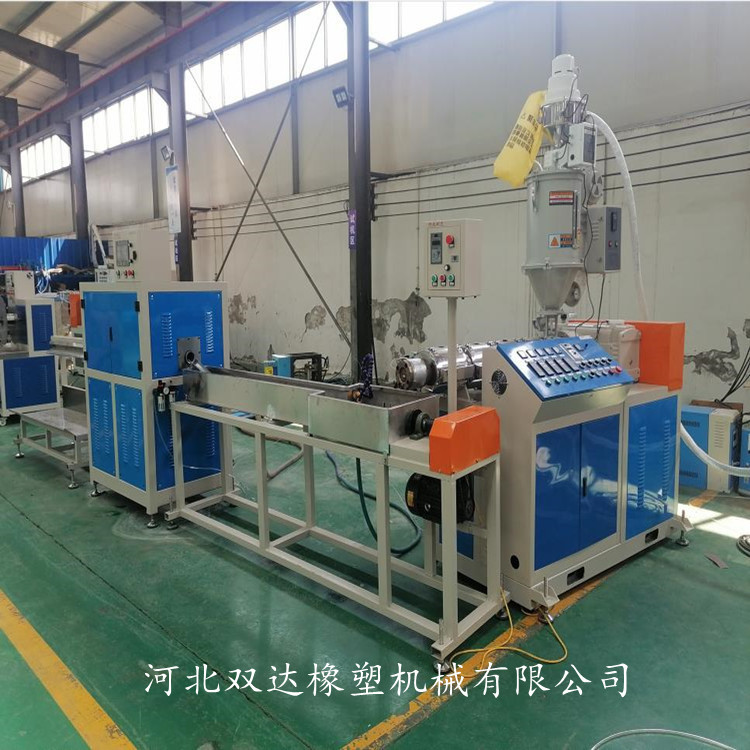
What is the operating principle of a single-screw extruder? A rubber extruder manufacturer explains it for you!
Rubber extruder manufacturer Friendly reminder: A single-screw extruder is typically divided into three sections based on its effective length. The effective lengths of these sections are determined by the screw diameter, pitch, and screw depth, usually accounting for about one-third of the total length. The first section, where material begins to be conveyed, is called the conveying zone. In this zone, the material is not yet plasticized but requires preheating and compression–extrusion. Early extrusion theory suggested that the material remained loose in this region; however, it has since been shown that the material behaves much like a solid piston, with its primary function being to transport the material forward. The second section is the compression zone, during which the cross‑sectional area of the screw channels is significantly reduced, and the temperature is raised to the level required for plasticization. Specifically, the volume of the screw channels decreases from roughly three times the initial value in the conveying zone to about one‑third—this ratio is known as the screw’s compression ratio, or 3:1. Some machines also incorporate an additional stage, where fully plasticized material enters the third section. The third section is the metering zone. Here, the material is maintained at the plasticization temperature, and, much like a metering pump, it delivers a precise, quantified flow of molten material to the die head. At this stage, the temperature must remain above the plasticization threshold, typically set slightly higher.
Rubber extruder manufacturer Friendly reminder: Energy savings in extruders can be divided into two components: the drive system and the heating system. Drive‑system energy savings: Most extruders now use variable frequency drives (VFDs), which reduce energy consumption by optimizing motor output. For example, if a motor is rated for 50 Hz but only requires 30 Hz during operation, the excess power would otherwise be wasted; VFDs achieve energy efficiency by adjusting the motor’s speed and power output accordingly. Heating‑system energy savings: In the heating section, electromagnetic heaters are commonly employed, delivering energy savings of approximately 30% to 70% compared with traditional resistance‑type heating elements.
What is the operating process of an extruder? A rubber extruder manufacturer explains it for you!
Rubber extruder manufacturer Friendly reminder: Plastic material enters the extruder from the hopper and is conveyed forward by the rotation of the screw. As it moves, it undergoes heating, shear, and compression, causing it to melt. Consequently, the material transitions among three states: glassy, highly elastic, and viscous flow. Under pressure, the molten material is forced through a die of a specific shape, taking on a cross‑section and profile similar to the die, thereby forming a continuous strand. The strand is then cooled and solidified in its glassy state, yielding the desired finished product.
Related news
Shuangda

Hebei Shuangda Rubber Machinery Co., Ltd.
Tel:400-0319-386
Landline:+86-319-6017632
Email:shuangdaxiangsu@126.com
Official website:www.shuangdajx.com
Addr:Liyuantun Industrial Zone, Weixian County, Xingtai City, Hebei Province
Copyright © 2022 Hebei Shuangda Rubber Machinery Co., Ltd.