




What is the structure of an extruder? A rubber extruder manufacturer is here to explain.
Time:
2022-08-09
Rubber extruder manufacturer: In extruders, the most common and widely used type is the single-screw extruder. Its structure typically comprises six main components: the drive system, the feeding device, the barrel, the screw, the die head, and the die. So, how does the extruder’s drive system work? Our rubber extruder manufacturer has the answer for you!
Rubber extruder manufacturer In an extruder, the most common and widely used type is the single-screw extruder. Its structure typically comprises six main components: the drive system, the feeding device, the barrel, the screw, the die head, and the die. So how does the extruder’s drive system work? A rubber extruder manufacturer is here to explain!
The drive system typically consists of an electric motor, a reducer, and bearings. During extrusion, the screw speed must remain constant and should not vary with changes in screw load to ensure consistent product quality. However, under different operating conditions, the screw speed may need to be adjusted to enable a single machine to process various types of plastics or products. Accordingly, this section commonly employs AC commutator motors, DC motors, and similar devices to achieve stepless speed control. The typical screw speed ranges from 10 to 100 revolutions per minute.
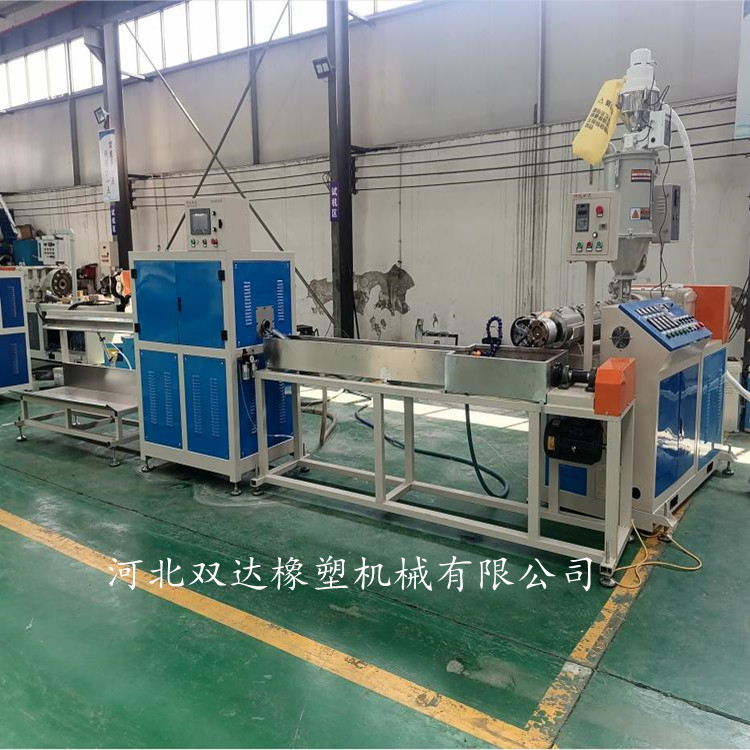
Rubber extruder manufacturer The drive system is responsible for powering the screw, providing the torque and rotational speed required during the extrusion process; it typically consists of an electric motor, a gearbox, and bearings. Under conditions of essentially identical design, the manufacturing cost of a gearbox is roughly proportional to its overall size and weight. Because gearboxes are relatively large in both dimensions and weight, their fabrication requires greater material inputs, and they necessitate larger bearings, thereby increasing production costs.
For extruders with the same screw diameter, high‑speed extruders consume more energy than conventional ones, requiring double the motor power and a corresponding increase in the number of gearbox bases. However, higher screw speeds correspond to lower gear ratios. Compared with gearboxes of the same size, lower‑ratio gearboxes feature larger gear module dimensions, which also enhance their load‑carrying capacity. Consequently, the increase in gearbox volume and weight does not scale linearly with the rise in motor power. When expressed as the ratio of extrusion output to gearbox weight, high‑speed extruders are fewer in number, while conventional extruders are more numerous. From a per‑unit‑output perspective, the smaller motor power and lighter gearbox weight of high‑speed extruders translate into lower machine‑manufacturing costs per unit of output compared to conventional extruders.
What is the feed system of an extruder? A rubber extruder manufacturer has the answer for you!
Granular materials are typically used for feeding, but ribbon‑type or powdered materials may also be employed. Loading equipment usually incorporates a conical hopper with a capacity sufficient to supply at least one hour’s worth of material. The hopper bottom is equipped with a shut-off device for regulating and interrupting material flow, while the sides feature inspection ports and calibration/measurement devices. Some hoppers may also include pressure‑relief or heating systems to prevent moisture absorption from the ambient air; additionally, certain bins are fitted with built-in agitators that enable automated feeding or charging.
What is the barrel of an extruder like? Rubber extruder manufacturer Here to help you!
These are typically metal barrels made of alloy steel or composite steel pipes with an alloy‑steel liner. Their key characteristics include high‑temperature and pressure resistance, robustness, wear resistance, and corrosion resistance. The barrel length is generally 15 to 30 times its diameter, with the optimal length determined by ensuring thorough heating and uniform plasticization of the material. The walls must be sufficiently thick and rigid, and the interior should be smooth; however, some designs feature grooves to increase friction with the plastic. Externally, the barrel is equipped with electric heaters, automatic temperature control systems, and cooling systems employing resistive or inductive heating methods.
Related news
Shuangda

Hebei Shuangda Rubber Machinery Co., Ltd.
Tel:400-0319-386
Landline:+86-319-6017632
Email:shuangdaxiangsu@126.com
Official website:www.shuangdajx.com
Addr:Liyuantun Industrial Zone, Weixian County, Xingtai City, Hebei Province
Copyright © 2022 Hebei Shuangda Rubber Machinery Co., Ltd.