




Working Principle of a Butyl Rubber Extruder
Time:
2025-08-31
The core operating principle of a butyl rubber extruder is as follows: the rotation of the screw, combined with heating and plasticization within the barrel, converts solid butyl rubber feedstock into a uniform molten state. This molten material is then forced through a die to form a specific cross-sectional profile, enabling continuous extrusion molding.
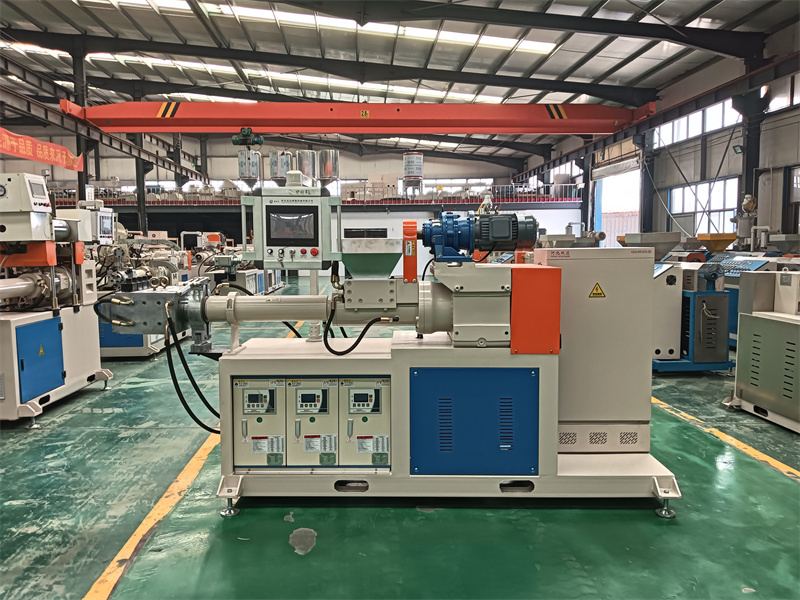
The core operating principle of a butyl rubber extruder is as follows: the rotation of the screw, combined with heating and plasticization within the barrel, converts solid butyl rubber feedstock into a uniform molten state. This molten material is then forced through a die to form a specific cross-sectional profile, enabling continuous extrusion molding.
The specific process can be divided into four key stages, arranged in the order of material flow within the equipment as follows:
1. Feeding stage Solid butyl rubber granules (or block material) enter the barrel from the hopper. The screw, driven by rotational thrust, conveys the raw material forward along the inner wall of the barrel, preparing it for subsequent plasticization.
2. Plasticizing stage As the raw material advances within the barrel, it undergoes plasticization through two concurrent mechanisms: first, segmented external heating of the barrel—typically in 3 to 5 zones at temperatures ranging from 120 to 180°C—which gradually softens the material; second, shear and compression generated by the clearance between the screw and the barrel, which further melts and homogenizes the material, ultimately yielding a uniform, flowable compound.
3. Homogenization stage The molten rubber compound is continuously conveyed toward the die by the screw; during this stage, the screw further compacts the compound, removes internal air bubbles, and ensures uniform temperature and viscosity, thereby laying the groundwork for stable extrusion.
4. Extrusion Molding Stage The uniformly molten polymer melt, driven by the screw’s thrust, enters the die head and, constrained within the die cavity, takes on a specific cross-sectional shape—such as a strip or a tube—and is continuously extruded through the die opening. It is then cooled and set to form the desired final product.
Related news
Shuangda

Hebei Shuangda Rubber Machinery Co., Ltd.
Tel:400-0319-386
Landline:+86-319-6017632
Email:shuangdaxiangsu@126.com
Official website:www.shuangdajx.com
Addr:Liyuantun Industrial Zone, Weixian County, Xingtai City, Hebei Province
Copyright © 2022 Hebei Shuangda Rubber Machinery Co., Ltd.