




Working principle of a rubber extruder
Time:
2022-09-28
The working principle of a rubber extruder: In our daily lives, we encounter numerous rubber products—car tires, for instance, are made of rubber, as are many other everyday items. Many of these products can be manufactured in a single step and are widely used in our everyday routines. Some shoe soles are also crafted from rubber. During the processing of rubber, a rubber extruder is required—a specialized machine designed to extrude rubber into desired shapes and forms. Now, let’s explore the operating principles and classifications of rubber extruders.
Rubber extruder The working principle of rubber extrusion is widely applied in our daily lives. Many rubber products are commonly seen—car tires, for instance, are made of rubber, and numerous other everyday items are also crafted from this material. Some products can be manufactured in a single step, making them quite prevalent in our routines. Even shoe soles are often made of rubber. During the processing of rubber, an extruder is required—a specialized machine designed to extrude materials into desired shapes. Now, let’s explore the operating principles and classifications of rubber extruders.
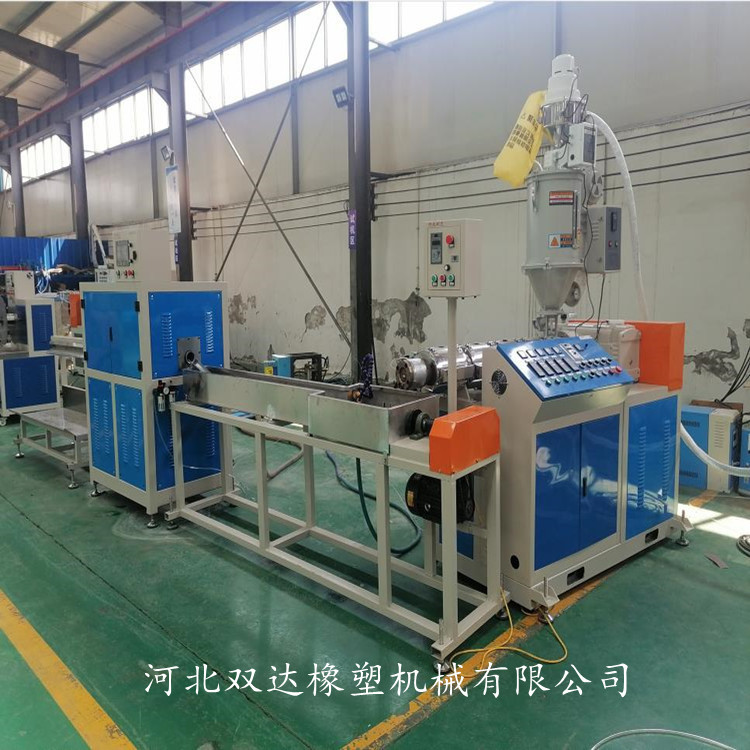
Rubber extruder Working principle: A rubber extruder carries out all the aforementioned processes within a barrel equipped with a screw and a helical channel. Plastic pellets enter the barrel through a hopper at one end and are conveyed toward the opposite end by the screw. The depth of the screw’s threads decreases as the distance from the hopper increases, thereby generating sufficient pressure. Friction between the plastic and the screw generates both external and internal heat. Classification of rubber extruders: During the first half of the 19th century, rubber extruders were primarily used for manufacturing lead pipes, processing pasta and other food products, as well as in the brick and ceramics industries.
The screw-type rubber extruder, which emerged in 1870, was a hot-feed extruder. The feedstock rubber had to be melted, homogenized, and supplied at a constant rate, with its temperature maintained between 50 and 70°C. Its screw was short, with deep flight grooves, resulting in suboptimal homogenization. Since the 1970s, the aspect ratio has been reduced. Thanks to its advantages—continuous extrusion, simple operation, high production efficiency, and stable product geometry—the hot-feed extruder remains widely used in the manufacture of numerous products. In tire production, it is employed to extrude various tread compounds and different types of rubber; in the fabrication of hoses, cables, and other rubber goods, it is used to produce extruded rubber and rubber blanks.
Cold-feed extruders first appeared in 1940, began to be widely adopted in the 1960s, and became the mainstream technology by the 1980s. By the early 1990s, in developed countries such as Europe and North America, cold-feed extruders accounted for 95% of total extruder production. These include single-screw extruders, barrier‑screw extruders, die‑screw extruders, transfer‑mixing extruders, pin‑screw extruders, and multi‑channel transfer‑mixing screw extruders.
Rubber extruder Its advantages include high output; it shares the other benefits of conventional twin-screw extruders and can achieve significantly higher production rates. Reduced production costs: When manufacturing masterbatches, color changes are frequent, and switching products typically requires opening the processing zone for several minutes. By observing the melt distribution along the screw, the mixing process can also be analyzed. Currently, conventional twin-screw extruders demand substantial amounts of cleaning compounds to purge the machine during color changes, which is both time‑consuming and energy‑intensive, while also wasting raw materials. A split‑type twin‑screw extruder addresses this issue: changing colors takes only a few minutes—simply open the cylinder and perform manual cleaning—thus minimizing or eliminating the need for extensive cleaning compounds and cutting costs.
Improving labor efficiency: In equipment maintenance, conventional twin-screw extruders typically require first dismantling the heating and cooling systems and then removing the entire screw assembly. By contrast, split‑type twin‑screw extruders allow operators to simply loosen a few bolts, turn the worm‑gear housing handle to lift the upper section of the extension barrel, thereby opening the entire barrel for servicing. This approach significantly reduces maintenance time and lowers labor intensity. Moreover, its broad application range makes it suitable for processing a wide variety of materials.
Related news
Shuangda

Hebei Shuangda Rubber Machinery Co., Ltd.
Tel:400-0319-386
Landline:+86-319-6017632
Email:shuangdaxiangsu@126.com
Official website:www.shuangdajx.com
Addr:Liyuantun Industrial Zone, Weixian County, Xingtai City, Hebei Province
Copyright © 2022 Hebei Shuangda Rubber Machinery Co., Ltd.