




Sharing Basic Knowledge About Glue Filtration Machines
Time:
2023-04-26
How much do you know about rubber and plastics? Nowadays, there are many specialized rubber manufacturers, and mechanical production has become more extensive and diverse, offering a wide range of equipment such as cold-feed extruders, rubber filters, foaming insulation‑material production lines, and rubber roller calendering lines. So let’s take a look at some common questions about these rubber‑processing machines. 1. Why does an extruded semi‑finished product shrink when it is left to stand? During idle periods, the thickness of an extruded semi‑finished product increases, while its length and width decrease. This phenomenon is generally referred to as “shrinkage.” For example, the length of tread compound may shorten by 2–5%. Like expansion, this shrinkage arises from the elastic recovery of the rubber material. When the rubber exits the die, it expands due to elastic recovery; however, during this process, the molecular chains experience internal viscous resistance, requiring time to reach equilibrium. Consequently, while the material remains at rest, elastic recovery continues, leading to further contraction. Therefore, after extrusion, semi‑finished products must be allowed to stand for a specified period—typically no less than two hours for tread compounds to stabilize, but not exceeding 72 hours to prevent surface contamination or deformation caused by prolonged standing. Also, avoid stacking or crowding the parts during storage. 2. What exactly is extruded by a rubber filter machine, and what are its key characteristics? 1) The screw’s length‑to‑diameter ratio is larger than that of conventional extruders, and its compression ratio is also…
How much do you know about rubber and plastics? These days, there are numerous specialized rubber manufacturers, and mechanical production has become more extensive and diverse, offering a wide range of equipment such as cold-feed extruders, rubber filters, foam insulation‑material production lines, and rubber roller calendering systems. So, let’s take a look at some common‑sense questions about these rubber‑processing machines.
1. Why do extruded semi-finished products shrink during storage?
During the parking process, the extruded semi‑finished product experiences an increase in thickness and a reduction in length and width. This phenomenon is commonly referred to as sinkage. For example, the length of tread compound may decrease by 2–5%.
Shrinkage, like expansion, arises from the recovery of elastic deformation in rubber materials. When the rubber is removed from the mold, it expands due to this elastic recovery. However, during this recovery process, the molecular chains experience viscous resistance, and it takes time for them to reach equilibrium. Consequently, even during a production pause, the rubber continues to recover elastically, leading to shrinkage. Therefore, after extrusion, semi‑finished products must be allowed to rest for a specified period—e.g., tread compound should be rested for at least 2 hours to ensure stability—while not exceeding 72 hours to prevent surface contamination or deformation during storage. During storage, avoid stacking or pressing the parts against one another.
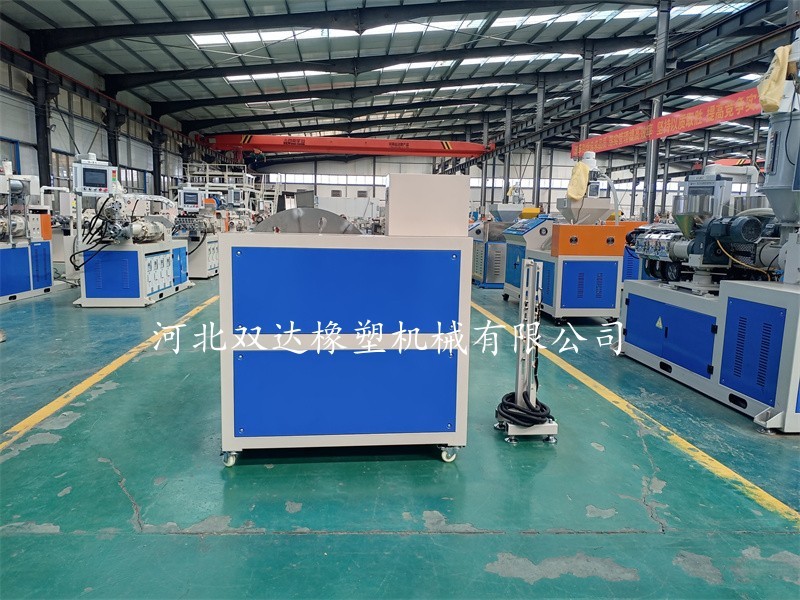
2. What is extruded by the gel filtration machine? What are its key characteristics when cooled?
1) The screw’s length-to-diameter ratio is greater than that of a conventional extruder, and its compression ratio is also higher.
2) The barrel is longer than that of a conventional extruder, and the end of the barrel is equipped with a feeding roller that is absent in standard extruders.
3) The gel filtration machine is equipped with a true pumping system, enabling genuine extrusion.
3. What is the purpose of gel filtration, and how does it differ from conventional extrusion?
Thin-walled rubber products and components, such as inner tubes, require filtration to achieve uniform plasticity and remove impurities. Filtration is carried out in a screw-type filter machine equipped with a die head fitted with multiple layers of metal mesh and a die head cover. Typically, inner tubes are processed using one layer of 44‑mesh screen and one layer of 30‑mesh screen. For products with stringent quality requirements, filters with 60‑mesh or even 80‑mesh screens are employed.
As the rubber compound passes through the rubber filter, its temperature rises due to shear. To prevent scorching, sulfur is typically added after filtration and before extrusion or calendering. Because butyl rubber has a high vulcanization temperature, sulfur can be incorporated prior to filtering. However, the temperature should not be excessively high; typical barrel temperatures range from 35 to 40°C, while die temperatures are maintained at 95 to 105°C.
The gearbox shall be lubricated with N150 medium‑pressure gear oil or another high‑quality gear oil of similar viscosity. Add lubricant until the oil level reaches the mark on the dipstick; this level should be confirmed after the oil has been evenly distributed throughout the housing. The oil level must be checked regularly, and under no circumstances should it fall below the lower limit. After 300–600 hours of operation, the oil should be changed once; thereafter, change the oil every 3,000 hours. Oil changes should be performed when the gearbox is stopped and the lubricant has not yet cooled. Rinse the housing thoroughly with oil of the same grade; if the oil is too viscous to allow effective flushing, preheat it first. Before starting a gearbox that has been idle for an extended period or in low ambient temperatures, run it at no load for a sufficient time to ensure adequate lubrication of all bearings before applying full load.
That concludes our introduction to the basics of gel filtration machines. We believe this overview will help you gain a better understanding of these devices.
Related news
Shuangda

Hebei Shuangda Rubber Machinery Co., Ltd.
Tel:400-0319-386
Landline:+86-319-6017632
Email:shuangdaxiangsu@126.com
Official website:www.shuangdajx.com
Addr:Liyuantun Industrial Zone, Weixian County, Xingtai City, Hebei Province
Copyright © 2022 Hebei Shuangda Rubber Machinery Co., Ltd.